

Roll and Wonder

Updated: 6 days ago
This week at Curiosity Club, we explored motion in a hands-on way during Roll and Wonder. With three different ramps to choose from, one smooth cardboard, one covered in aluminum foil, and one with a rough textured surface, children investigated how objects move depending on shape, weight, slope, and surface.
It didn’t take long for the questions to start!!
Three Ramps, Three Stories
Each ramp looked similar, but they told different stories once objects started moving.
The aluminum foil ramp was smooth and reflective. The rough ramp added resistance. The plain cardboard sat somewhere in between. Children quickly began comparing what changed from one surface to another.
They were able to choose from toy cars, rubber balls, tennis balls, paper towel tubes, square blocks, animal figurines, and even a fluffy toy horse, dolls, and a loofah.
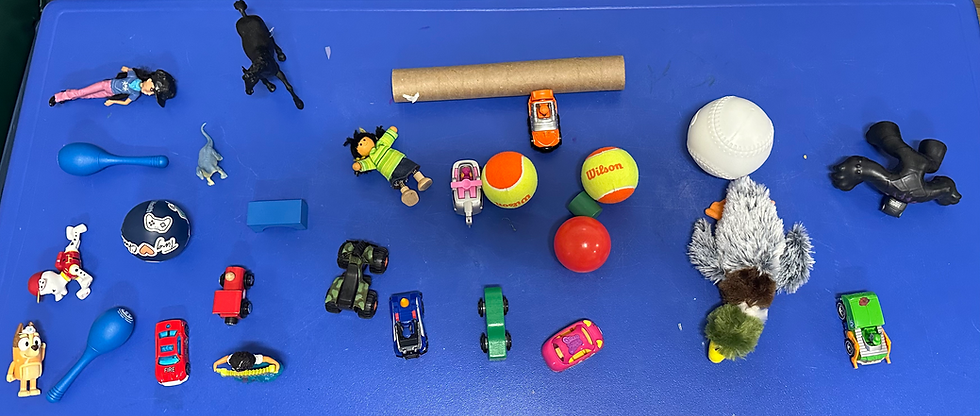
Some objects zipped down the foil ramp. Others slowed dramatically on the rough surface. A few didn’t roll at all, they flipped, slid, or wobbled unpredictably.
We heard a lot of thoughtful wondering:
“What if we race them?”
“What if the cars go backwards?”
Instead of directing, facilitators paused and asked:
“I wonder what will happen if we roll this one?”
“Which do you think will go faster or slower?”
Changing the Height
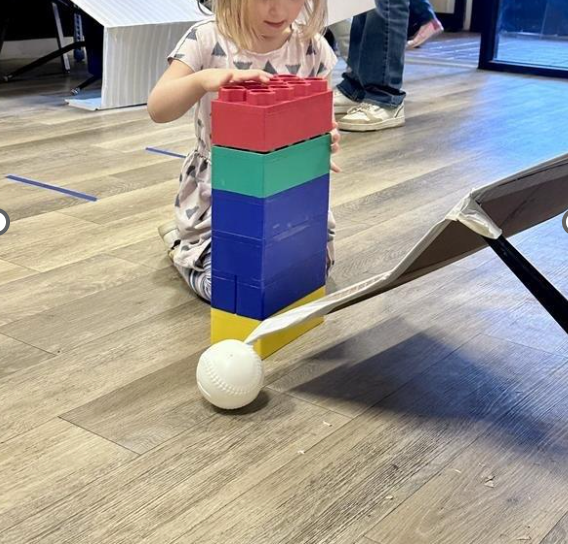
One ramp was adjustable. Children stacked large LEGO-style blocks underneath to change its height. When the ramp grew steeper, objects picked up speed in a way that felt almost dramatic. When it was lowered, movement softened and slowed. Some children raised it as high as they could. Others just added one block and made small, careful adjustments, watching closely.
We heard:
“What changed when we made the ramp higher?”
“How fast can we push it so that it goes over the steep ramp?”
With each adjustment, children weren’t just playing, they were also noticing patterns.
When Things Don’t Move as Expected

Not everything rolled the way children predicted. The fluffy horse slid awkwardly. The loofah hesitated. Square blocks tumbled instead of gliding. Dolls shifted direction mid-descent. These moments brought the most wonder.
Facilitators asked:
“What do you notice about how that one moves?”
"Why do you think that is happening?"
Children began to see that round shapes behave differently than flat edges, surface texture matters, and height changes speed. Those small details create big differences. The ramps became less about reaching the bottom and more about understanding the journey.
How Roll and Wonder Promoted Curiosity
Comfort within uncertainty: Objects didn’t behave the same way on every ramp. Children were encouraged to observe before explaining.
Alternative ideas: Racing, stacking blocks, pushing instead of releasing, each new approach led to a different result.
Free exploration: With three ramps and flexible materials, children had time to test, compare, and return to their questions.
Cultivate Curiosity at Home
You can cultivate curiosity at home by praising question asking. When you encourage children's natural curiosity, it grows. You can even take it a step further by helping them explore answers on their own!
Examples:
"What a creative question! Let's go look it up!"
"I'm so glad you asked that! How do you think we could find out?"
Missed Roll and Wonder? We hope to see you at our next Curiosity Club session for more hands-on exploration and moments of noticing together!


Comments